Israel Mission Trip - Page 5
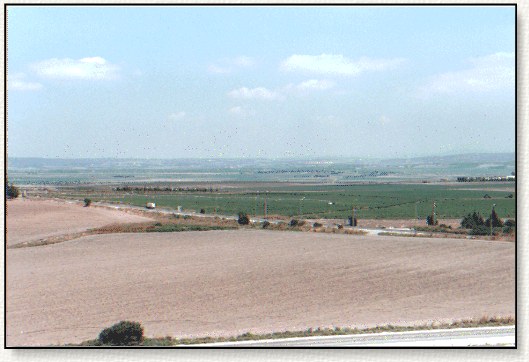
A photograph of the Jezreel Valley or the Valley of Armageddon.
From the Holman Bible Dictionary:
ARMAGEDDON (ahr muh gehd' dahn) A Middle East site of the final battle between the forces of good and evil (Rev. 16:16). The word "Armageddon" appears once in Scripture and is not found in Hebrew literature. Translators transliterate the term from Greek into English in several ways: Armageddon (KJV); Har Magedon (NASB); and Harmageddon (Moffatt). The Greek is a transliteration of the Hebrew har megiddo, literally, "mountain of Megiddo." Revelation promises that in the face of defeat of God's saints by military forces from the east, south, and the north, the Lord Jesus Christ will return to defeat His enemies and deliver His people. The location of Armageddon indicates that the Middle East has historial importance in the last days. Armageddon, or the Mount of Megiddo, is located in the plain of Esdraelon or Jezreel, a valley fourteen by twenty miles in size. The location is near the ancient city of Megiddo. Here ran the ancient highway between Egypt and Damascus. Many decisive battles had been fought here. It would be natural to think of it as the site of the last and greatest battle of all. One of the most stunning and decisive defeats for God's people took place here when King Josiah perished in battle with Pharaoh-nechoh (2 Kings 23:29-30). This defeat burned deeply in the Jewish mind. The final battle of history, discussed in Revelation 19:17-21, will be one of victory. Even the secular world has popularized Armageddon, especially since the coming of the Atomic Age, as that catastrophic event in history that would destroy the human race. The reality that God will bring defeat on the forces of evil at Armageddon should lead all people to examine themselves, their plans, and their actions to see if they might be part of the evil forces rather than part of the work of God's kingdom.
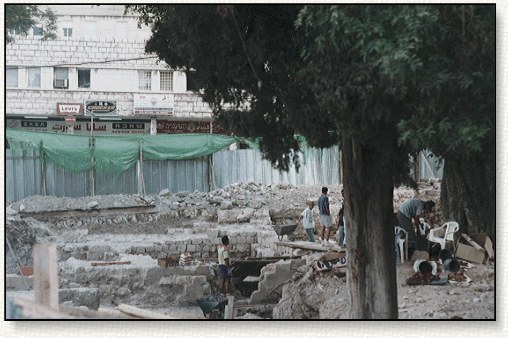
The only water well in Nazareth. It is called Mary's well. The well is being repaired for the year 2000. People believe Jesus Christ and his mother used this water well for it is the only one in the town of Nazareth.
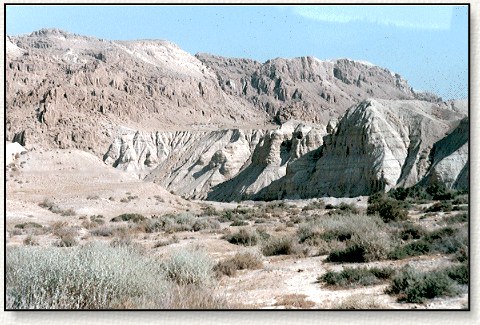
This is where they found the dead sea scrolls. The cave is the dark area in-between the two shadows almost in the center of the photograph.
From the Holman Bible Dictionary:
DEAD SEA SCROLLS The Dead Sea Scrolls were discovered between 1947 and 1960 in a cave on the western Dead Sea shore near a ruin called khirbet Qumran. Eleven caves from the Qumran area have since yielded manuscripts, mostly in small fragments. About sixty percent of the scrolls have so far been published. These were composed or copied between 200 B.C. and A.D. 70, mostly around the lifetime of Jesus, by a small community living at Qumran.
Contents They comprise three main kinds of literature: (1) copies of Old Testament books, the oldest we now possess; (2) some non-biblical Jewish books known from elsewhere (such as 1 Enoch and Jubilees), probably written by the Essenes; (3) the community's own compositions, including: biblical commentaries (for example, on Habakkuk and Nahum), which interpret biblical prophecies as applying to the community and its times; rules of community conduct; and liturgical writings such as prayers and hymns.
The Essenes The Qumran community belonged to the Essenes, one of four major Jewish religious movements described by the first century A.D. historian Josephus, but, strangely, unmentioned in the New Testament. The origins of the Essenes are uncertain: one major view is that they descended from the "Pious," who had fought for religious independence with the Maccabees; on another view they originated in Exile in Babylonia, returning to Palestine sometime in the third or second century B.C. They opposed the cultic laws operating at the Temple, rejecting its priesthood, and following a different calendar. They lived apart from other Jews in strictly-disciplined groups. One such rather special group lived at Qumran. Unlike many Essene groups, they were celibates, and they traced their origin to a "Teacher of Righteousness," a messianic figure of whom little is known except that he was a priest, possibly a high priest. The Qumran biblical commentaries speak of his confrontation with a "Wicked Priest," possibly a Maccabean high priest of about 150 B.C.
Beliefs and Practices The Scrolls show a surprising variety of beliefs, accounted for by two hundred years of community history, beginning with a belief in an eminent "end of days" which faded as the fulfilment did not materialize. Like other Essenes, they believed that by observing their own interpretation of the Jewish law and by frequent ritual bathing they preserved a faithful remnant. Thus they were ready for the restoration of the land by God, who would punish the wicked through two messiahs--one priestly, one lay. They had an interest in angels, astrology, and prophetic prediction. Peculiar to Qumran was a dualistic view of the world in which God had appointed an angel of light (one of his names being Melchizedek; see Gen. 14; Heb. 7) and an angel of darkness to govern the world, all persons being assigned to the realm of one or the other. They also avoided the Temple and developed distinctive liturgical beliefs and practices based on a communion between earthly and angelic worship.